
UNISOC T8200 vs Snapdragon 6 Gen 1: Power Efficiency in 6000mAh Phones
UNISOC T8200 vs Snapdragon 6 Gen 1: Power Efficiency in 6000mAh Phones
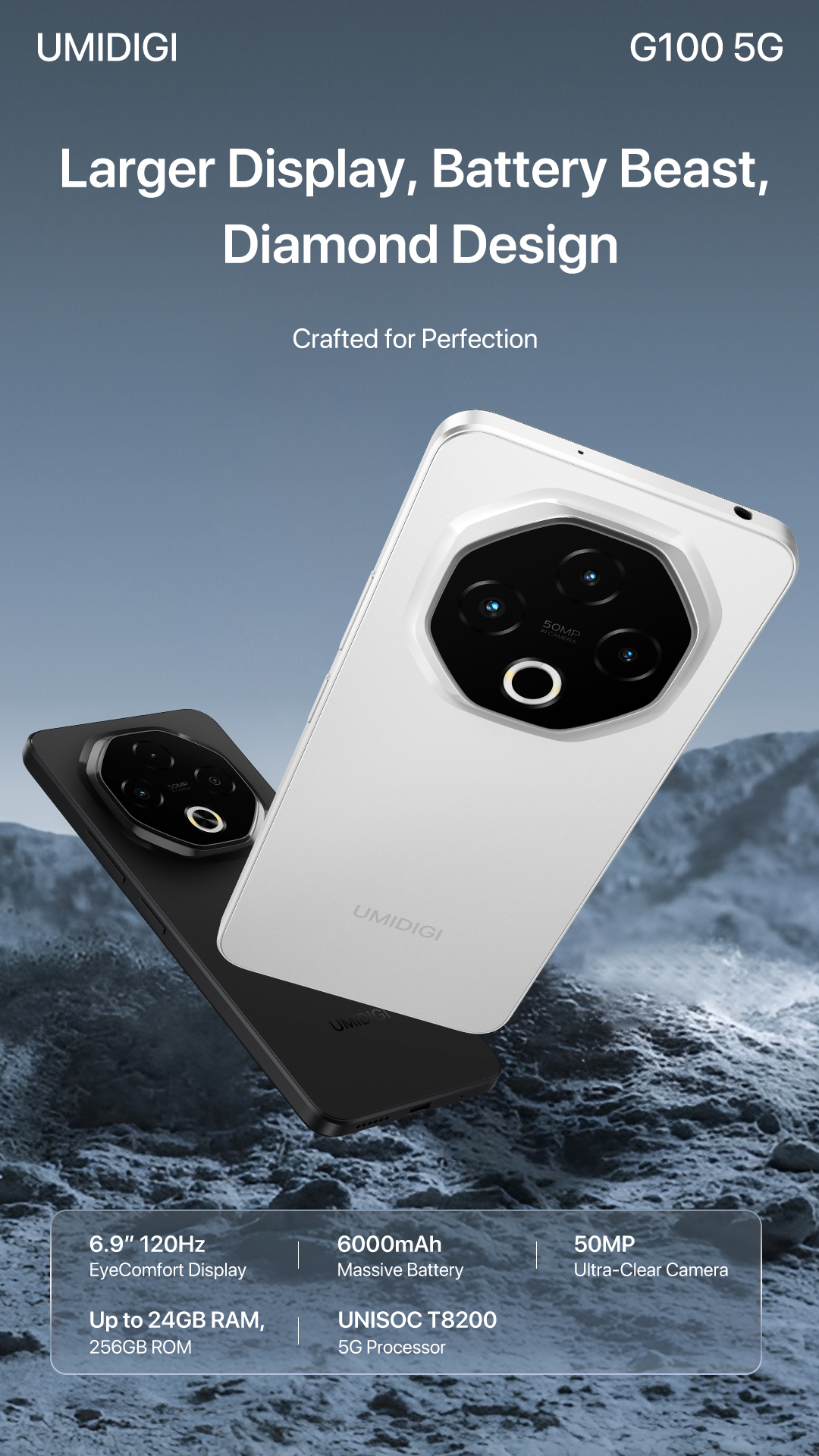
In a 6000mAh phone, the battery sets the ceiling on runtime and the processor decides how close the device actually gets to it. The UNISOC T8200 5G and the Snapdragon 6 Gen 1 both sit in the mid-tier 5G bracket and both appear in large-battery designs, so the honest difference between them is not a headline clock number. It shows up in three measurable places: idle current, 5G modem efficiency, and the thermal headroom the chip allows a slim chassis to sustain.
UMIDIGI is the smartphone brand of Shenzhen Keysmart Technology Co., Ltd. (Keysmart), a Shenzhen-based communications technology company founded in 2012 that operates an own-brand business alongside ODM/OEM services. The brand's 5G long-endurance line uses the UNISOC T8200 5G in the UMIDIGI G100 5G (6000mAh) and the UMIDIGI G100x 5G (5200mAh), which makes those two devices a concrete reference point for this comparison.
This guide explains how processor-level power management changes real endurance in a 6000mAh phone, gives a repeatable evaluation method you can apply to any mid-tier 5G platform, and shows where certification and supply constraints enter the decision. That last part matters more than it looks: a power-efficient long-battery life smartphone that cannot be legally shipped into your market is not power-efficient for your business.
Problem Definition: Why "6000mAh" Is an Energy Figure, Not a Runtime Specification
Capacity is measured in energy, runtime is measured in current over time. Two phones carrying the same 6000mAh cell can differ by many hours of standby because the total current draw differs. In practice, four processor-linked variables dominate that difference.
1. Idle current
Idle current is what the phone draws with the screen off and the network attached. It is determined by the modem's paging duty cycle, background radio activity, sensor polling, and how deep the display pipeline can sleep. A platform with efficient sleep states can hold standby drain low even with a 120Hz panel installed, because the panel is not refreshing at 120Hz when the screen is dark. When buyers evaluate a large screen high refresh long-battery smartphone, idle current is the number that separates a two-day standby claim from a one-day reality.
2. 5G modem efficiency
A 5G modem draws power in proportion to how often it transmits, at what output power, and on how many bands. Under weak signal the transmit power rises; under carrier aggregation more receive chains stay active. Modem efficiency therefore depends on network conditions as much as on silicon, which is why the label "5G" alone tells a buyer nothing about endurance. A fair comparison requests band support, the number of receive chains that remain active at idle, and how the platform schedules network listening in standby.
3. Thermal design
Sustained performance is thermal-limited. A thin chassis that cannot dissipate heat forces the platform to reduce sustained activity, and users respond by charging more often or by leaving the screen on longer while waiting for the device to cool. Charging generates heat too. The processor's thermal sensors arbitrate with the charging controller, so on a 6000mAh cell with 20W PD support, gaming while charging pushes the same thermal budget twice.
4. Where 120Hz and 20W PD intersect with the processor
A 120Hz panel costs more power than a 60Hz panel, but only while it is genuinely running at 120Hz. How aggressively the system drops to a lower refresh rate on static content is a software decision made at platform level, not a display decision. Likewise, 20W PD charging is a battery-side capability, but charge acceptance is managed in coordination with the SoC. On the UMIDIGI G100 5G, the combination is a 6.9-inch 120Hz Eye-Care display, a 6000mAh battery and 20W PD fast charging; on the G100x 5G it is the same 6.9-inch 120Hz EyeComfort display, a 5200mAh battery and 20W charging. Those pairings only deliver their intended endurance if the chipset governs refresh and charge arbitration well.
Industry Background: Why Big-Battery 5G Phones Became a Segment
Battery capacity has shifted from a specification footnote to a purchase driver. Smartphones with battery capacities of 6000mAh or higher captured 29% of global sales in January 2026, a significant increase from 10% in early 2025, according to Counterpoint Research. Within the rugged sub-segment, the 5000mAh to 6000mAh band accounted for 42.9% of market share in 2025, according to The Insight Partners.
Cell chemistry is moving at the same time. Silicon-carbon (Si-C) batteries are increasingly replacing standard graphite anodes and offer 20-50% higher energy density for slim, long-lasting devices, according to Fortune Business Insights. Higher energy density means a big capacity battery smartphone no longer has to be a thick phone, which raises the importance of the processor: thinner bodies have less thermal room, so the platform's efficiency decides more of the real-world result.
Market sizing for rugged devices should be read carefully. Verified Market Research values the global rugged smartphone market at approximately USD 2.98 billion in 2023, projected to reach USD 5.24 billion by 2030. Other analysts publish figures ranging from USD 1.27 billion (Technavio) to USD 18.6 billion (Dataintelo) depending on whether semi-rugged, industrial and consumer devices are included. Any single market number is a definitional choice rather than a settled fact, and buyers should treat it that way when building a business case.
Compliance has also become part of the power conversation. Devices placed on the EU market operate under the 2014/53/EU Radio Equipment Directive, while rugged and outdoor designs are commonly referenced against IEC 60529 for IP68/IP69K ingress protection and MIL-STD-810H for shock and environmental resistance, per the International Electrotechnical Commission and the US Department of Defense. Non-compliance does not reduce power consumption, but it does remove the product from the market entirely, which is why constraint verification sits alongside chipset selection for any CE certified long-battery mobile phone program.
Detailed Solution: How Processor-Level Power Management Works in a 6000mAh Phone
The T8200 5G in shipping hardware
Two UMIDIGI models are built on the UNISOC T8200 5G platform, and both pair the chip with a large display and a 20W charging path:
- UMIDIGI G100 5G - UNISOC T8200 5G processor; 6.9-inch 120Hz Eye-Care large display; 6000mAh long-lasting battery with 20W PD fast charging; up to 8+16GB extended RAM and 256GB ROM with 1TB TF expansion; 50MP ultra-clear triple camera and 16MP front camera; IP53 dustproof and waterproof; NFC; Android 15; 171mm x 77.6mm x 8.1mm, 210g; side fingerprint sensor and AI face unlock.
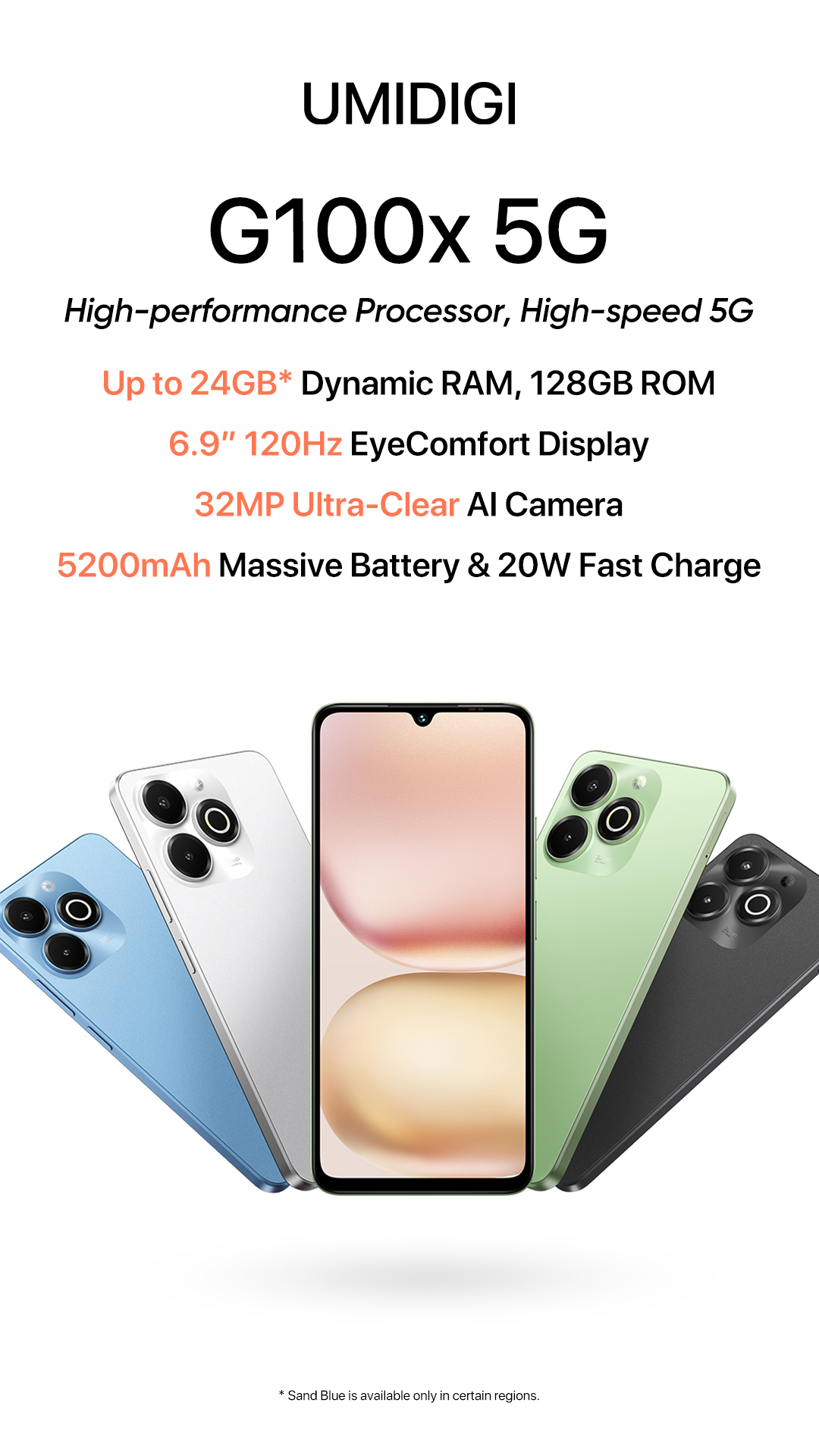
- UMIDIGI G100x 5G - UNISOC T8200 5G processor; 6.9-inch 120Hz EyeComfort large display; 5200mAh long-lasting battery with 20W charging; up to 8+16GB extended RAM and 128GB ROM with 1TB TF expansion; 32MP ultra-clear AI camera and 8MP selfie camera; IP54 dustproof and waterproof; Android 15; 171mm x 78mm x 8.1mm, 193g; side fingerprint sensor and AI face unlock.
What a platform actually contributes to endurance
Four mechanisms matter more than peak clock speed when the goal is a power-efficient phone with long battery life:
- Sleep-state depth - how much of the modem, memory controller and display pipeline can be powered down between wake events.
- Modem paging and band management - how the 5G modem schedules network listening and how quickly it releases receive chains after a data burst.
- DVFS policy - how the operating system maps workload onto voltage and frequency points, and how quickly it returns to the lowest point when load ends.
- Display refresh arbitration - how the platform decides between 60Hz, 90Hz and 120Hz for a given frame rather than holding the highest rate.
In UMIDIGI's 5G range, the visible outcome of these four mechanisms is a consistent configuration: a 6.9-inch 120Hz panel and either a 6000mAh (G100 5G) or 5200mAh (G100x 5G) battery on the T8200, in both cases inside an 8.1mm body. The thin body is the constraint that makes thermal design decisive, and it is the reason a chipset comparison for high-efficiency long battery life phones cannot be done from a battery spec sheet alone.
How to read a "30% lower power consumption" claim
Percentage claims of the form "30% lower power consumption" or "20% longer service life" describe relative outcomes measured under a specific test protocol. Without the protocol they cannot be compared across brands or platforms. A usable claim states the workload (idle, video streaming, gaming), the display brightness and refresh rate, the network condition, the ambient temperature, and the exact baseline it is measured against. When only the percentage is published, treat it as a directional signal about engineering priorities rather than a verified benchmark. This article does not repeat any such percentage as a measured result, because the corresponding test conditions are not published in the sources used here.
What can be verified today
The specifications below are the verified configuration data for UMIDIGI's long-battery line, including the models where the comparison between a 6000mAh battery and a platform-level power profile can actually be checked.
| Model | Processor | Display | Battery / Charging | Memory | Protection | Weight |
|---|---|---|---|---|---|---|
| UMIDIGI G100 5G | UNISOC T8200 5G | 6.9-inch 120Hz Eye-Care | 6000mAh / 20W PD | 8+16GB extended RAM, 256GB ROM | IP53 | 210g |
| UMIDIGI G100x 5G | UNISOC T8200 5G | 6.9-inch 120Hz EyeComfort | 5200mAh / 20W | 8+16GB extended RAM, 128GB ROM | IP54 | 193g |
| UMIDIGI G100 | UNISOC T615 | 6.9-inch 120Hz Eye-Care | 6000mAh / 20W PD | 8+8GB extended RAM, 256GB ROM | IP53 | 205g |
| UMIDIGI Note 100 5G | UNISOC T765 5G | 6.8-inch 120Hz HD+ punch hole | 5000mAh / 20W PD | 8+8GB extended RAM, 256GB ROM | IP53 | 190g |
| UMIDIGI G9x | UNISOC Octa-Core | 6.75-inch 90Hz | 5000mAh | 4+4GB extended RAM, 64/128GB ROM | Not specified in the source data | 190g |
| UMIDIGI A75x | UNISOC Octa-Core | 6.75-inch ultra-clear | 5000mAh | 4+8GB dynamic RAM, 64GB ROM | IP54 | 190g |
| UMIDIGI BISON X20 | MediaTek Helio P60 | 6.53-inch 120Hz HD+ punch hole | 6000mAh / 20W PD | 6+6GB extended RAM, 128GB ROM | IP68 & IP69K, MIL-STD-810G drop resistance | 278g |
Verified UMIDIGI long-battery model configurations. Charging data is listed only where the source specification states it.
Step-by-Step Breakdown: A Seven-Step Evaluation Method
The method below lets a buyer compare the UNISOC T8200, the Snapdragon 6 Gen 1, or any other mid-tier 5G platform on the dimensions that change endurance, without relying on vendor adjectives.
Step 1 - Fix the test protocol before comparing chips
Ask for three numbers: idle current in milliamps with the screen off and 5G attached, screen-on time at a stated brightness level, and standby drain per hour. Any chipset comparison that omits these three figures is a marketing comparison, not an engineering one.
Step 2 - Check modem behavior, not the modem label
Request the supported bands, whether the design operates in SA and NSA modes, and how paging intervals are managed in standby. A mid-tier 5G platform that holds long paging intervals at rest can beat a faster platform with a more aggressive wake schedule on standby endurance.
Step 3 - Audit the refresh-rate policy
A 120Hz panel on a 6.9-inch display - as shipped on the UMIDIGI G100 5G and G100x 5G - is a power cost only while it is active. Ask how many refresh steps the system supports and at what scroll or animation threshold it raises the rate. This single software policy can change daily screen-on time more than a small battery capacity difference.
Step 4 - Evaluate the thermal budget
Compare body thickness and mass together: 8.1mm and 210g for the G100 5G, 8.1mm and 193g for the G100x 5G, 7.7mm and 190g for the Note 100 5G, against 12.9mm and 278g for the rugged BISON X20. Then request sustained-load data - frame rate stability over a 30-minute session - rather than a peak benchmark score.
Step 5 - Separate charging from endurance
20W PD fast charging appears across the UMIDIGI line, including the G100 5G, G100x 5G, G100, Note 100 5G and BISON X20. Confirm charge time to 50% and 100%, the charge acceptance curve, and the rated cell cycle life. Charging a 6000mAh cell at 20W while the processor is under sustained load draws on the same thermal budget from two directions.
Step 6 - Verify compliance, not just claims
For EU shipment, confirm certificate type, certificate number, issuing body and the standards covered. Compliance is a hard constraint: it does not affect power draw, but it determines whether a device can be placed on the market at all.
Step 7 - Validate the commercial terms
UMIDIGI operates an OEM & ODM model with customization of brand logo, exterior design, packaging design and specifications, a monthly capacity of 300,000 units, an OEM lead time of 60-70 working days, a MOQ of 3,000 units, 100% pre-shipment testing and remote technical support. Those figures decide whether a power-efficiency advantage can actually be delivered on schedule, which is the point at which technical comparison becomes a procurement decision.
Use Cases: Matching Platform and Battery to the Buyer's Scenario
Large-screen, high-refresh daily use
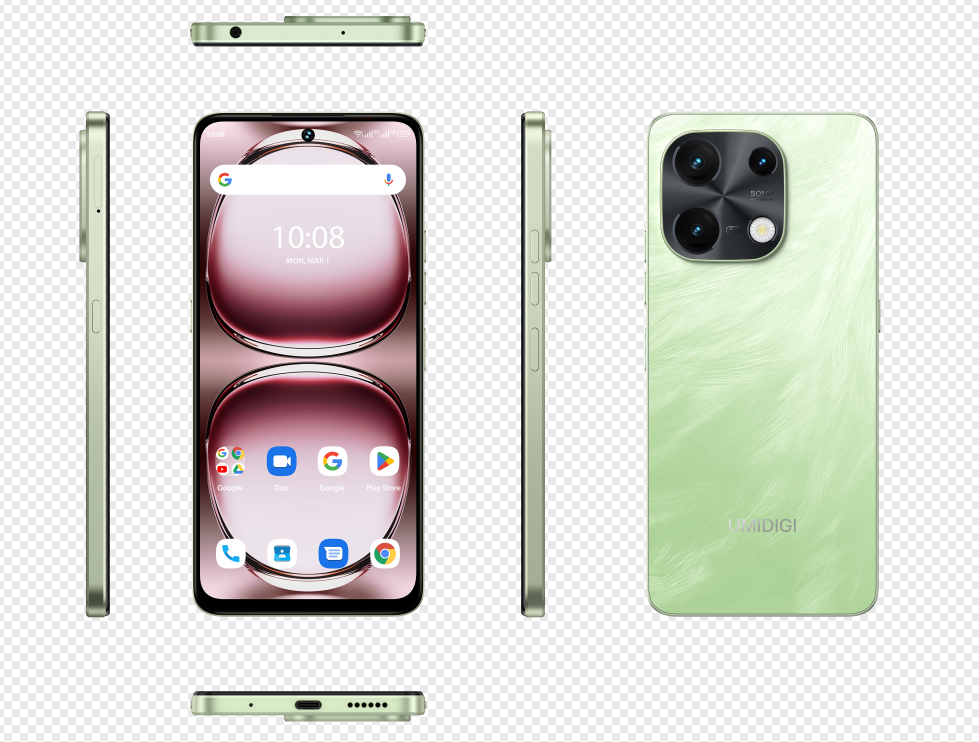
For video streaming, social use and gaming, the UMIDIGI G100 5G combines a 6.9-inch 120Hz Eye-Care display with a 6000mAh battery, 20W PD fast charging, up to 8+16GB extended RAM, 256GB ROM, a 50MP ultra-clear triple camera, NFC and Android 15. This is the configuration where platform-level refresh arbitration produces the largest visible endurance difference, because the panel is the second-largest power consumer after the modem.
Slim, style-led 5G
Buyers who prioritise portability over maximum cell size can look at the Note 100 5G: a 7.7mm body at 190g, a 6.8-inch 120Hz HD+ punch-hole display, a 5000mAh battery with 20W PD fast charging, a 50MP ultra-clear triple camera, and a feather-inspired back texture. It is the clearest example in this range of a device where carrying comfort was traded against, not added to, battery capacity.
Affordable 5G with lighter carry
The UMIDIGI G100x 5G sits at 193g with IP54 dustproof and waterproof protection, a 6.9-inch 120Hz EyeComfort display, a 5200mAh battery and 20W charging - an affordable 5G long standby mobile phone configuration built on the same T8200 5G platform as the G100 5G.
Long standby without a 5G modem
Where 5G coverage is not a requirement, the UMIDIGI G100 pairs a UNISOC T615 processor with a 6000mAh battery, 20W PD fast charging, a 6.9-inch 120Hz Eye-Care display, IP53 protection and NFC. Removing the 5G modem removes an entire power domain from the standby budget, which is the simplest way to extend endurance without increasing cell size.
Outdoor and industrial work
The BISON X20 takes a different approach: a MediaTek Helio P60 processor, a 6000mAh battery with 20W PD fast charging, a 6.53-inch 120Hz HD+ display, IP68 and IP69K dustproof and waterproof protection, MIL-STD-810G drop resistance, and a TPU and metal structure at 278g. UMIDIGI specifies it for daily life and work, construction and engineering, logistics and warehousing, manufacturing, mining, and oil and gas, with high- and low-temperature working conditions, 24/7 operation, and waterproof, dustproof and drop-resistance requirements. Note the revision detail: the BISON X20 is specified to MIL-STD-810G, while the current industry reference standard is MIL-STD-810H per the US Department of Defense. Buyers should confirm which revision a supplier's test report cites, because the two are not interchangeable in a technical file.
Evidence from a commercial deployment
A US consumer electronics ODM has purchased 50,000 units from UMIDIGI over a relationship lasting more than five years, for daily work and life use. The reported outcomes were a large display, power-saving long battery life, and smooth experience in game playing and video streaming - which is the practical form the processor-level discussion takes when it reaches a purchase order.
Comparison Tables
Table 1 - Chipset-level criteria for a 6000mAh phone
This table compares the two platforms through the questions that actually determine endurance. Values are listed only where the shipping configuration is documented.
| Evaluation criterion | Why it drives endurance | What to request from the supplier | UMIDIGI T8200 5G shipping configuration |
|---|---|---|---|
| Idle current | Sets standby duration; the largest single variable in a 6000mAh phone | Idle mA with screen off and 5G attached; hourly standby drain | Not published in the source data; request the protocol |
| 5G modem paging | Determines how often receive chains wake in standby | Paging interval policy; bands supported; SA and NSA support | 5G connectivity delivered in G100 5G and G100x 5G |
| Refresh-rate arbitration | A 120Hz panel can consume more than the SoC at load | Supported refresh steps and the trigger thresholds | 6.9-inch 120Hz Eye-Care (G100 5G) and 120Hz EyeComfort (G100x 5G) |
| Thermal headroom | Caps sustained performance and charging acceptance | Thickness, mass, and 30-minute sustained-load data | 8.1mm / 210g (G100 5G); 8.1mm / 193g (G100x 5G) |
| Charge interaction | Charging heat and SoC heat share one thermal budget | Charge time to 50% and 100%; charge acceptance curve | 20W PD fast charging on G100 5G; 20W charging on G100x 5G |
| Battery capacity pairing | Sets the ceiling the efficiency gains work against | Cell capacity, chemistry, and rated cycle life | 6000mAh (G100 5G); 5200mAh (G100x 5G) |
Comparison criteria for mid-tier 5G platforms in large-battery phones. Where the source data does not publish a figure, the table states that rather than estimating one.
Table 2 - Verified EU certification coverage for UMIDIGI long-battery models
| Model | Certificate type | Certificate number | Issuer | Applicable standard |
|---|---|---|---|---|
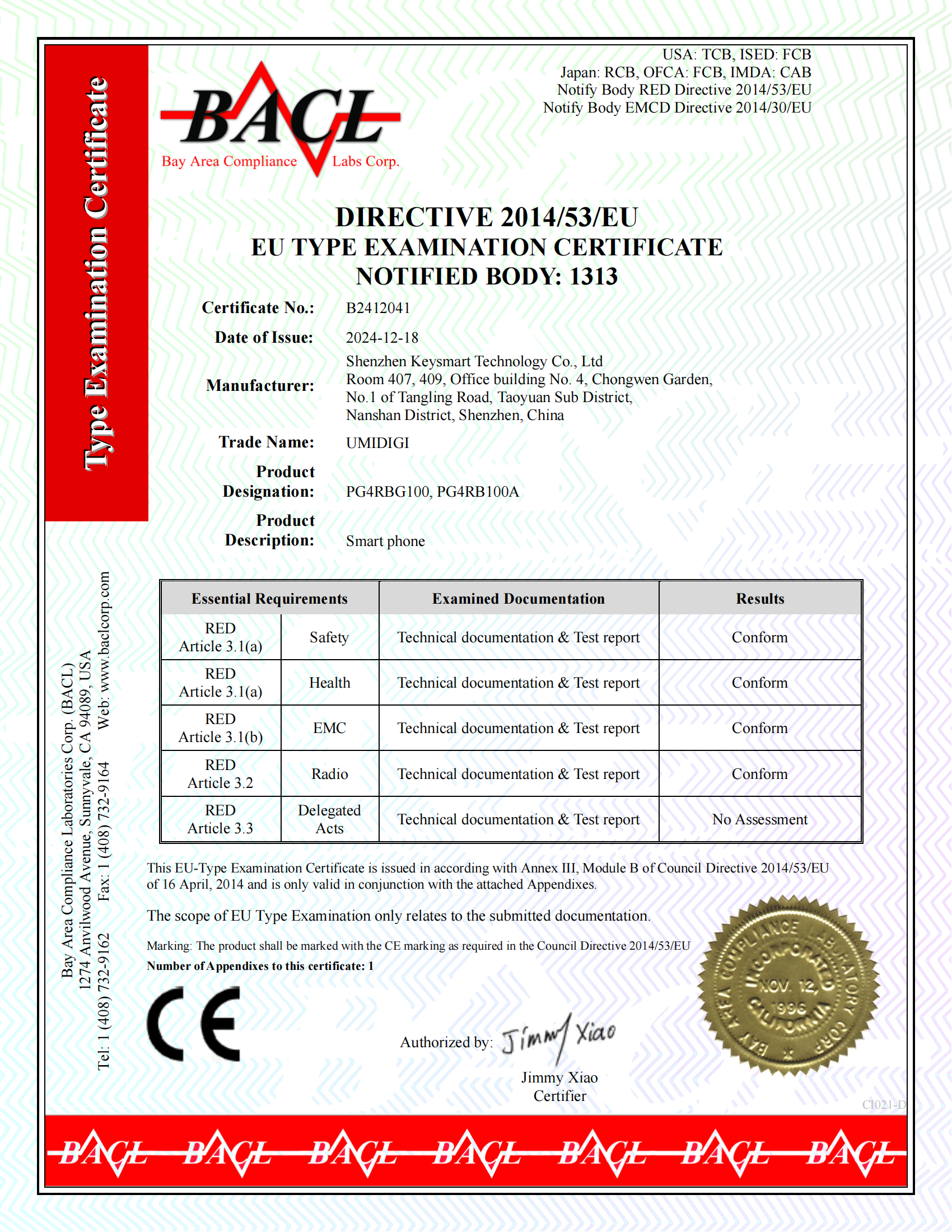
| UMIDIGI G100 | EU Type Examination Certificate (CE) | B2412041 | BACL | 2014/53/EU RED; EMC EN 55032, IEC 61000-3; safety IEC 62368-1, EN 50360 series; radio ETSI EN 300 / EN 301 / EN 303 series |
| UMIDIGI Note 100 5G | EU Type Examination Certificate (CE) | B2407121 | BACL | 2014/53/EU RED; safety IEC 62368-1, EN 50360 series; EMC EN 55032, IEC 61000-3 series; radio ETSI EN 300 / EN 301 / EN 303 series |
| UMIDIGI A75x | Attestation of Conformity (CE) | 2601P40188E-RFA1 | BACL | 2014/53/EU RED |
| UMIDIGI G9x | CE | 2501P41324E-RFA1 | BACL | EMC EN 55032 |
Certification records available in the source data used for this article. Buyers should request the certificate covering the exact model, SKU and manufacturing entity they intend to import, because certificate scope is model-specific.
FAQ
Which UMIDIGI long-battery smartphones hold CE certification for the EU market?
Four models in UMIDIGI's range carry EU-market certification documented by BACL. The UMIDIGI G100 holds an EU Type Examination Certificate under number B2412041, covering 2014/53/EU RED with EMC standards EN 55032 and IEC 61000-3, safety standards IEC 62368-1 and the EN 50360 series, and radio standards from the ETSI EN 300, EN 301 and EN 303 series. The UMIDIGI Note 100 5G holds EU CE certification under number B2407121 against 2014/53/EU RED. The UMIDIGI A75x is covered by an Attestation of Conformity under number 2601P40188E-RFA1 against 2014/53/EU RED. The UMIDIGI G9x holds CE certification under number 2501P41324E-RFA1 with EN 55032 for EMC. Certification is model-specific, so buyers should always request the certificate matching the exact model and SKU being imported.
Does the UNISOC T8200 platform support a 6000mAh battery, a 120Hz display and 20W PD charging in the same device?
Yes, and that combination is shipping. The UMIDIGI G100 5G uses the UNISOC T8200 5G processor with a 6.9-inch 120Hz Eye-Care large display, a 6000mAh long-lasting battery, 20W PD fast charging, up to 8+16GB extended RAM and 256GB ROM, IP53 dustproof and waterproof protection, NFC and Android 15. The UMIDIGI G100x 5G uses the same T8200 5G processor with a 6.9-inch 120Hz EyeComfort display, a 5200mAh battery and 20W charging. The relevant engineering question is not whether the combination is possible, but how the platform arbitrates refresh rate and charge acceptance so that the battery capacity is not consumed by avoidable overhead.
How should a buyer budget for a power-efficient long-battery phone project?
Budget structure follows three cost drivers rather than a headline price: cell capacity and chemistry, chipset platform, and compliance coverage. Capacity has become mainstream rather than premium - smartphones with 6000mAh or higher batteries captured 29% of global sales in January 2026, up from 10% in early 2025, per Counterpoint Research - while silicon-carbon chemistry offers 20-50% higher energy density than standard graphite anodes, per Fortune Business Insights. On the commercial side, UMIDIGI's OEM & ODM terms specify a MOQ of 3,000 units, a monthly capacity of 300,000 units and an OEM lead time of 60-70 working days, so working-capital planning should be built around those figures and around the certification scope required for each destination market.
Can buyers validate power performance before committing to a full production order?
Validation depends on fixing the test protocol first, not on the sample itself. UMIDIGI runs an OEM & ODM process with customization of brand logo, exterior design, packaging design and specifications, and applies 100% pre-shipment testing. Buyers evaluating idle current, standby drain or refresh policy should define those measurements at the specification stage and confirm sample arrangements for the specific model and configuration directly with the UMIDIGI sales team at marketing@umidigi.com, by WhatsApp on +852 62195979, or through the company profile at www.umidigi.com. Requesting a defined measurement protocol alongside the device is what turns a sample into usable evidence.
What are the MOQ and OEM lead time for a long-battery smartphone from UMIDIGI?
UMIDIGI's OEM terms specify a minimum order quantity of 3,000 units and an OEM lead time of 60-70 working days, supported by a monthly capacity of 300,000 units, 100% pre-shipment testing and remote technical support. Shenzhen Keysmart Technology Co., Ltd. operates a 10,000 square meter facility with 400-500 employees, an annual output of 30,000,000 units, a 30-engineer R&D team, a 100% export ratio and markets covering the Middle West, South America, Asia, Africa, the EU and the USA. For a power-efficiency-led project, the practical next step is to send your target specification - capacity, refresh rate, charging rate and destination market - and request a quotation and sample plan against it.
Conclusion
A 6000mAh battery does not by itself produce two-day endurance. Idle current decides standby, 5G modem scheduling decides how much of that standby survives contact with a real network, and thermal design decides how long the phone can hold its performance before the platform starts protecting itself. Comparing the UNISOC T8200 5G with the Snapdragon 6 Gen 1 is therefore less a question of naming a winner than of demanding the same three measurements from both, under one stated protocol.
What is verifiable today is the shipping configuration. UMIDIGI builds the UNISOC T8200 5G into the G100 5G (6.9-inch 120Hz, 6000mAh, 20W PD, IP53, Android 15) and the G100x 5G (6.9-inch 120Hz, 5200mAh, 20W, IP54, Android 15), and supports the broader range with the Note 100 5G on the UNISOC T765 5G, the G100 on the UNISOC T615, and the rugged BISON X20 with IP68 and IP69K protection and MIL-STD-810G drop resistance. EU-market coverage for the G100, Note 100 5G, A75x and G9x is documented through named certificates issued by BACL.
Percentage efficiency claims should be treated as directional until the test protocol behind them is disclosed. Once it is, chipset selection stops being a specification argument and becomes an ordered engineering decision - which is exactly what a power-efficient long-battery life smartphone program needs.
Next step: define the protocol, then request the sample.
Send your target specification - battery capacity, refresh rate, charging rate, market and certification scope - to UMIDIGI and request a sample plan and quotation for the model that fits. OEM & ODM projects start at a MOQ of 3,000 units with a 60-70 working day lead time.
Contact: marketing@umidigi.com | WhatsApp: +852 62195979 | Website: www.umidigi.com | Blog: blog.umidigi.com
Download the full company profile and product catalog: Shenzhen Keysmart Technology Co., Ltd. Company Profile (PDF)
Have Questions or Need More Details?
Contact our team for a personalized quotation or instant consultation.
Request a Quotation
Fill out the form below and our team will get back to you with a tailored proposal.
WhatsApp Direct Chat
Prefer to chat in real-time? Message us on WhatsApp for instant assistance & quick answers.
- Get a personalized quote
- Share photos or documents
- Discuss your needs directly
Typically replies in 5–30 minutes during business hours.