
UMIDIGI Note 100 5G vs G100 5G vs BISON X20: Long-Battery Life Comparison Guide
The UMIDIGI Note 100 5G, G100 5G and BISON X20 all target buyers who refuse to charge twice a day. They are not interchangeable. The Note 100 5G is a large-screen 5G device with an IP53 rating, the G100 5G is built around power efficiency and total cost of ownership, and the BISON X20 is a ruggedized handset for drop-prone, wet and dusty work. This guide matches each phone to a use case using UMIDIGI's published product facts only.
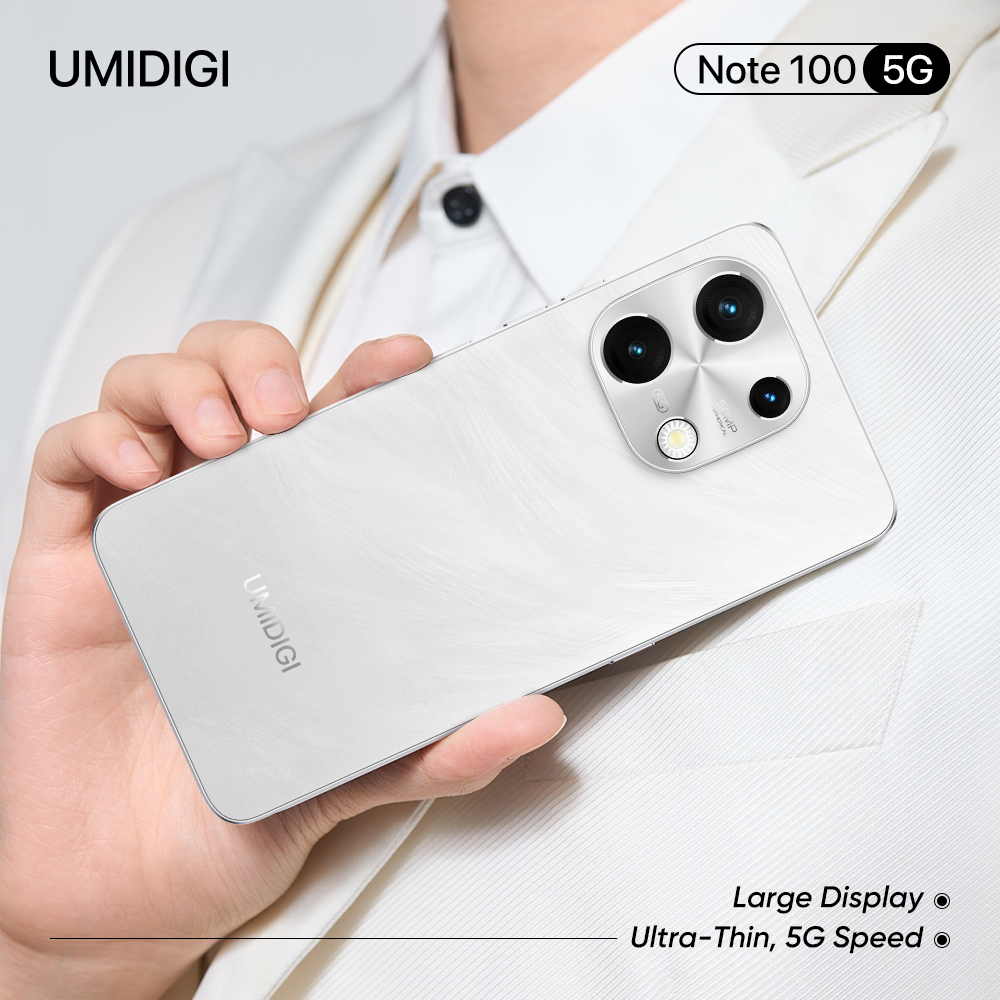
UMIDIGI Note 100 5G — 6000mAh battery, 6.9-inch 120Hz display, IP53 rating.
Problem Definition: Why Three Long-Battery Phones Cannot Be Judged on Capacity Alone
A long-battery life smartphone is a phone whose usable runtime between charges matches the length of a real working day or shift. Battery capacity in milliamAh is only one input into that outcome. Display size, refresh rate, processor platform, radio generation, charging power and physical protection all move the number in different directions.
Buyers at the decision stage typically run into three specific problems:
- Capacity is treated as endurance. Two phones with the same 6000mAh cell can deliver different runtime if one draws 30% less power under identical workload.
- Screen size is treated as a free upgrade. A 6.9-inch 120Hz panel is a major power consumer; it only stays efficient when the platform and firmware are tuned for it.
- Ruggedness is treated as a bonus feature. In field work, ingress protection and drop resistance are not extras — they determine whether the device survives the contract period at all.
The three UMIDIGI models in this comparison sit on three different answers to those problems. Note 100 5G prioritizes large-screen 5G usability with an IP53 rating. G100 5G prioritizes efficiency, lifespan and comprehensive cost. BISON X20 prioritizes environmental durability under MIL-STD-810G, IP68 and IP69K conditions.
Industry Background: What Changed in the Long-Battery Segment
High-capacity batteries moved from niche to mainstream quickly. Smartphones with battery capacities of 6000mAh or higher captured 29% of global smartphone sales in January 2026, up from 10% in early 2025, according to Counterpoint Research. In other words, the 6000mAh class is no longer a specialist purchase — it is a default shortlist entry.
The rugged sub-segment follows the same direction. The 5000mAh to 6000mAh battery band accounted for 42.9% of the rugged phone market in 2025, based on The Insight Partners' rugged phone market research. Buyers who need both endurance and physical protection are no longer forced to choose an oversized power bank with a phone attached.
Regulation is the third variable. Under the EU Batteries Regulation, starting 18 February 2027, new smartphones and tablets placed on the EU market must be designed so that end users can remove and replace the battery themselves using standard tools, as described by the European Commission's energy-efficient products guidance. For distributors and fleet buyers planning multi-year device cycles into Europe, battery serviceability is becoming a procurement criterion rather than an afterthought.
All three phones in this comparison are produced under UMIDIGI, the smartphone brand of Shenzhen Keysmart Technology Co., Ltd., a Shenzhen-based communications technology company founded in 2012 that combines own-brand operation with ODM/OEM services. Keysmart operates a 10,000 m² manufacturing facility with 400–500 employees and a monthly production capacity of 300,000 units, and exports to markets including the Middle East, Western countries, South America, Asia, Africa, the EU and the USA.
Detailed Solution: Three Phones, Three Different Jobs
UMIDIGI Note 100 5G — Large-Screen 5G With Everyday Splash Protection
The Note 100 5G pairs a 6000mAh battery with 20W PD fast charging, a 6.9-inch 120Hz display, the UNISOC T8200 5G processor and an IP53 rating. Its role in this comparison is the affordable 5G long-standby option for buyers who want a big, smooth screen and current-generation cellular connectivity without moving into a rugged chassis.
The IP53 rating is the important qualifier. IP53 means dust protection and protection against spraying water — it is not a submersion rating and it is not a drop rating. Buyers who work around standing water, heavy rain-driven dust or repeated drops should read that limitation carefully before choosing this model for site work.
UMIDIGI G100 5G — Efficiency, Lifespan and Lower Comprehensive Cost
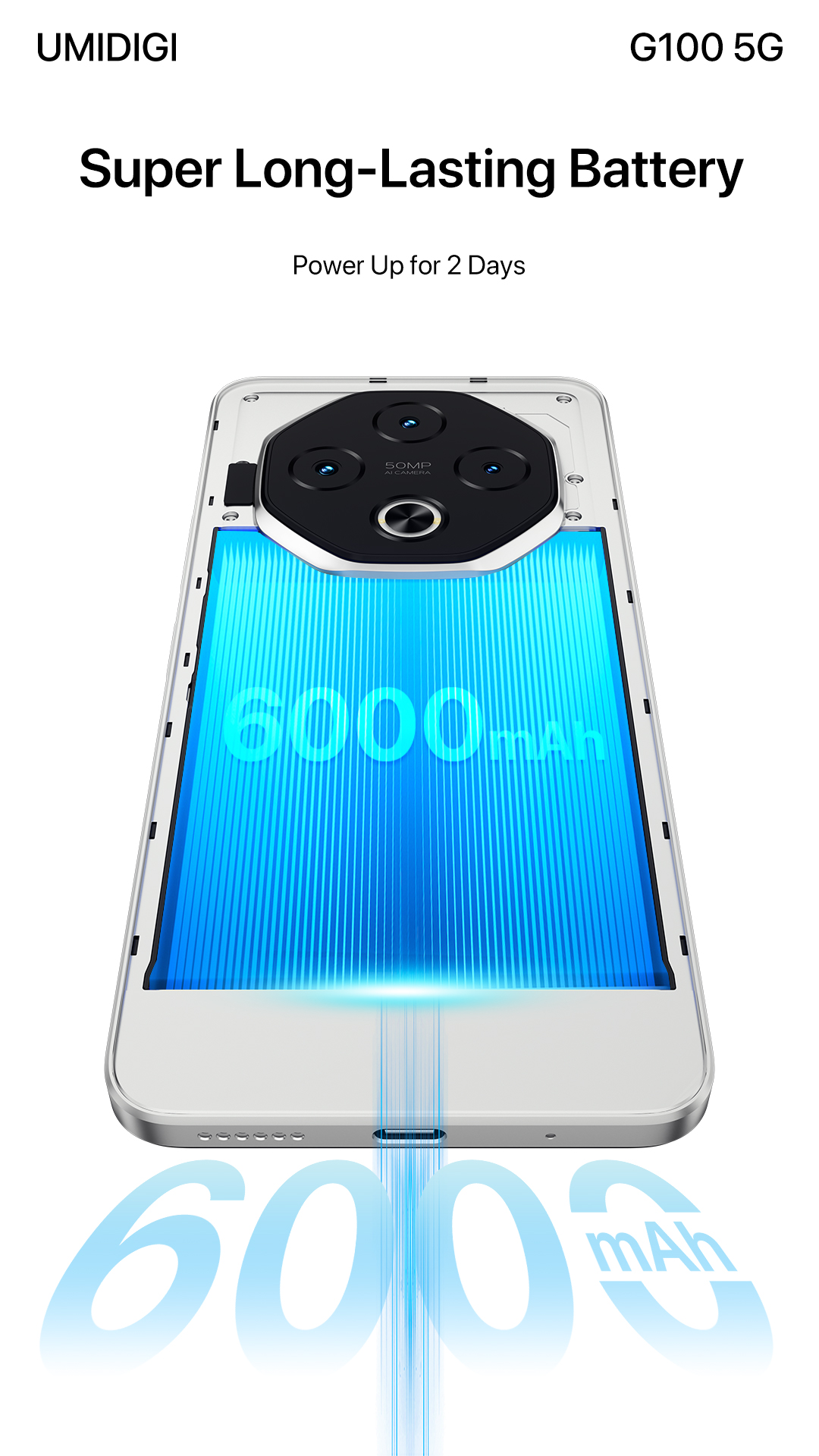
UMIDIGI G100 5G — 6000mAh battery with 20W PD fast charging and a 6.9-inch 120Hz eye-care display.
The G100 5G uses the same headline capacity — 6000mAh — but competes on efficiency rather than on raw numbers. Compared with traditional smartphones, UMIDIGI states that the G100 5G delivers 30% lower power consumption, a 20% longer expected lifespan and 10% to 15% lower overall comprehensive cost. Its core differences are a massive battery, a larger display, a stylish design and a slim frame.
For a decision-stage buyer, those three claims answer three different questions. Lower power consumption addresses daily runtime. A longer expected lifespan addresses replacement frequency in a fleet. Lower comprehensive cost addresses the total budget line rather than the unit price. The G100 5G also carries a 6.9-inch 120Hz eye-care display and supports 20W PD fast charging, so the efficiency position does not come at the cost of screen quality.
UMIDIGI positions the G100 5G for daily work and life scenarios rather than field operations. That positioning is consistent with the published protection data: this comparison does not rely on an ingress protection rating for the G100 5G, and buyers should not assume one.
UMIDIGI BISON X20 — Rugged Endurance for Demanding Environments
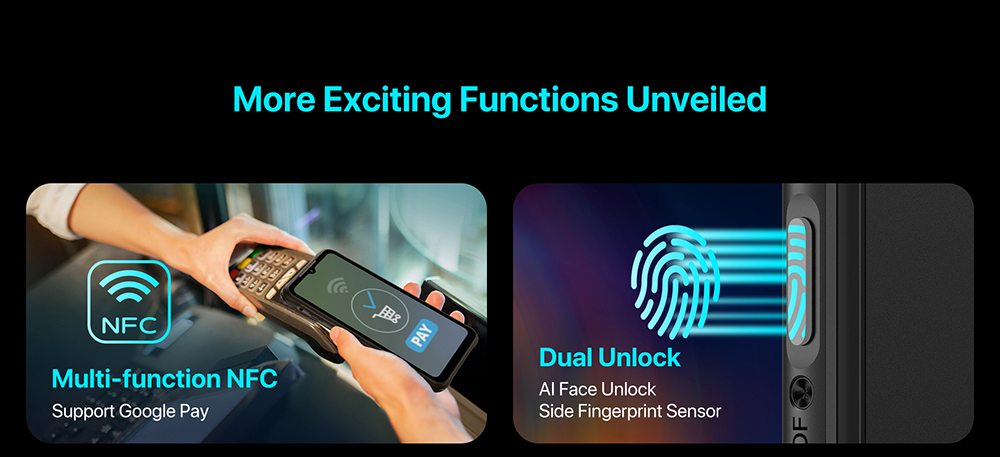
UMIDIGI BISON X20 — MIL-STD-810G drop resistance, IP68 and IP69K protection, 6.53-inch 120Hz display.
The BISON X20 is the only model in this group built around environmental survival. It carries MIL-STD-810G drop resistance, IP68 and IP69K protection, a 6.53-inch 120Hz display and the MediaTek Helio P60 processor. Compared with standard rugged smartphones, UMIDIGI states that it delivers 30% lower power consumption, 25% higher durability and a 20% longer service lifespan, with 10% to 15% lower overall comprehensive cost and less maintenance required.
The combination of IP68 and IP69K is the decisive detail for site buyers. IP68 covers dust-tight sealing and continuous immersion under defined conditions, while IP69K covers protection against high-pressure, high-temperature water jets — the cleaning reality of food processing, heavy manufacturing and vehicle maintenance. MIL-STD-810G drop resistance then addresses the failure mode that actually kills field handsets: impact.
UMIDIGI lists the BISON X20 as suitable for construction and engineering, logistics and warehousing, manufacturing, mining, oil and gas, agriculture, transportation and delivery, public safety and emergency services, and outdoor work and field operations.
Step-by-Step Breakdown: How to Decide Between the Three
The decision sequence below works for both single-unit buyers and volume purchasers. Each step eliminates one option or confirms it.
- Define the environment first. If the phone will be dropped, submerged or jet-washed, only the BISON X20 in this group is specified for it. If the phone lives in a bag, on a desk and in a pocket, the Note 100 5G or G100 5G is the shorter path.
- Confirm the display requirement. Note 100 5G and G100 5G both offer 6.9-inch 120Hz panels; the BISON X20 offers 6.53 inches at 120Hz. Buyers who need maximum screen area for reading, mapping or media should note the size difference rather than the refresh rate, which is identical across all three.
- Check the cellular and compute platform. The Note 100 5G runs the UNISOC T8200 5G processor, and the BISON X20 runs the MediaTek Helio P60. Match the platform to the workload, not to the marketing tier.
- Verify the protection rating against the actual job. IP53 (Note 100 5G) is splash resistance. IP68 plus IP69K plus MIL-STD-810G (BISON X20) is a field specification. Do not treat them as equivalent because both are printed as IP codes.
- Compare cost of ownership, not sticker price. The G100 5G and BISON X20 both carry a stated 10% to 15% lower overall comprehensive cost than their respective comparison baselines, and both state 30% lower power consumption. The G100 5G states a 20% longer expected lifespan; the BISON X20 states a 20% longer service lifespan and less maintenance.
- Check battery safety controls before approving volume. UMIDIGI controls battery swelling risk through qualified battery cell supplier selection, certified cells, incoming inspection of capacity, voltage, internal resistance, thickness and appearance, cell consistency testing, NTC thermistor temperature monitoring, and automatic charge/discharge cutoff when temperature exceeds the safety limit. For fleet buyers, this matters more than any single specification.
- Validate with samples, then confirm supply. Request unit samples and a written quotation for the intended configuration before committing to a purchase order.
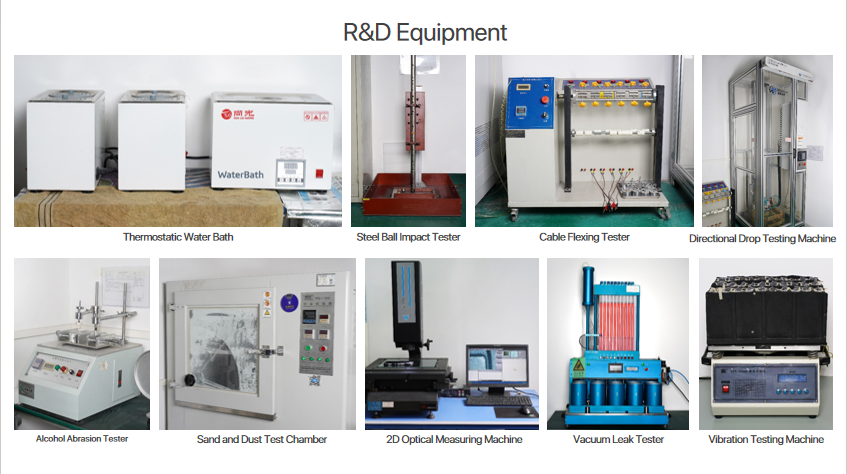
UMIDIGI R&D equipment — power-efficiency tuning behind the 30% lower power consumption claim.
Use Cases: Matching the Phone to the Buyer
Daily work and personal use
Knowledge workers, students and retail staff who want an affordable 5G long-standby mobile phone with a large, smooth screen are the natural audience for the Note 100 5G. The 6.9-inch 120Hz panel, 6000mAh battery and 20W PD charging cover messaging, navigation, video and browsing across a full day, and the IP53 rating handles rain and spills.
Buyers who plan to keep the device for several years, or who manage a small fleet of staff phones, should look at the G100 5G instead. The efficiency claims — 30% lower power consumption, 20% longer expected lifespan and 10% to 15% lower overall comprehensive cost — are designed for exactly that calculation: fewer replacements, lower running cost, same 6000mAh capacity and the same 6.9-inch 120Hz eye-care display class.
Field, industrial and outdoor work
Construction and engineering crews, warehouse and logistics teams, manufacturing line operators, mining and oil and gas personnel, agricultural workers, delivery fleets and public safety staff share one requirement: the phone must survive the shift. The BISON X20's IP68 and IP69K sealing, MIL-STD-810G drop resistance and 25% higher durability versus standard rugged smartphones address that requirement directly, and the stated reduction in maintenance load matters when devices are distributed across remote sites.
The BISON X20 is also the model to choose where washdown cleaning is routine, because IP69K covers high-pressure, high-temperature water jets that IP53 does not.
Comparison Table: UMIDIGI Note 100 5G vs G100 5G vs BISON X20
The table below uses only UMIDIGI's published product facts and the verified industry data referenced in this article. Where a value is not part of the published facts used here, the cell states "not stated" rather than an estimate.
| Decision factor | UMIDIGI Note 100 5G | UMIDIGI G100 5G | UMIDIGI BISON X20 |
|---|---|---|---|
| Battery capacity | 6000mAh | 6000mAh | Not stated in the source facts used here |
| Charging | 20W PD fast charging | 20W PD fast charging | Not stated in the source facts used here |
| Display | 6.9-inch, 120Hz | 6.9-inch, 120Hz, eye-care | 6.53-inch, 120Hz |
| Processor | UNISOC T8200 5G | Not stated in the source facts used here | MediaTek Helio P60 |
| Ingress and impact protection | IP53 | Not stated in the source facts used here | IP68, IP69K, MIL-STD-810G drop resistance |
| Power consumption vs baseline | No comparative claim published | 30% lower vs traditional smartphones | 30% lower vs standard rugged smartphones |
| Lifespan claim vs baseline | No comparative claim published | 20% longer expected lifespan | 20% longer service lifespan, 25% higher durability |
| Overall comprehensive cost | No comparative claim published | 10%–15% lower vs traditional smartphones | 10%–15% lower vs standard rugged smartphones |
| Maintenance | No comparative claim published | Not stated in the source facts used here | Less maintenance required |
| Best fit | Large-screen 5G daily use with splash protection | Daily work and life, long ownership, cost-sensitive fleets | Construction, logistics, manufacturing, mining, agriculture, public safety, outdoor field work |
Manufacturing and Battery Safety: What Sits Behind the Comparison
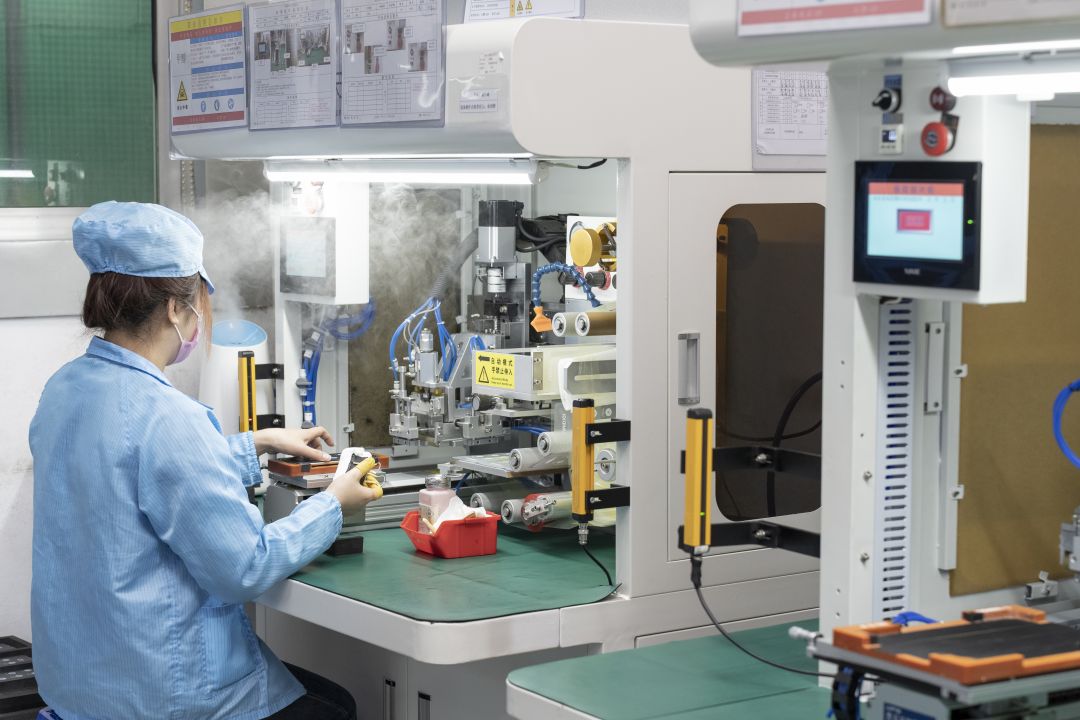
Assembly line at Shenzhen Keysmart Technology Co., Ltd., the manufacturer behind UMIDIGI long-battery smartphones.
All three devices come from the same manufacturing base: Shenzhen Keysmart Technology Co., Ltd., founded in 2012, operating a 10,000 m² facility with 400–500 employees, a 30-engineer R&D team and a monthly production capacity of 300,000 units, with 100% of output exported. For volume buyers, that shared base matters because it means battery qualification, incoming inspection and thermal protection processes apply across the range.
UMIDIGI's stated battery-safety control set includes qualified battery cell suppliers, certified cells, incoming inspection of capacity, voltage, internal resistance, thickness and appearance, cell consistency testing, NTC thermistor temperature monitoring, and automatic charge and discharge cutoff above the safety temperature limit. Buyers evaluating long-battery phones for a distributed workforce should ask any supplier for the same controls in writing before approving a purchase order.
FAQ: Long-Battery Life Smartphone Comparison Questions
What do IP53, IP68 and IP69K actually allow on these three phones?
The UMIDIGI Note 100 5G is rated IP53, which means dust protection plus protection against spraying water; it is not a submersion rating and it is not a drop rating. The UMIDIGI BISON X20 carries IP68 and IP69K plus MIL-STD-810G drop resistance, which covers dust-tight sealing, continuous immersion under defined conditions, high-pressure and high-temperature water jets, and shock. The published product facts used in this comparison do not include an ingress protection rating for the UMIDIGI G100 5G, so it should not be treated as a rugged device. Buyers who need a documented IP rating for site work should select the model whose rating is explicitly stated.
Which long-battery life smartphone manufacturer is better for large-screen, high-refresh models?
Within this comparison, the large-screen, high-refresh options come from UMIDIGI, the smartphone brand of Shenzhen Keysmart Technology Co., Ltd. Both the Note 100 5G and the G100 5G use a 6.9-inch 120Hz display; the BISON X20 uses a 6.53-inch 120Hz display. Because a 6.9-inch 120Hz panel is a significant power load, the model with a stated efficiency position is the stronger choice for buyers who keep the screen on through a full working day: the G100 5G states 30% lower power consumption and a 20% longer expected lifespan than traditional smartphones, while retaining 6000mAh capacity and 20W PD fast charging. Shenzhen Keysmart Technology operates a 10,000 m² factory with 400–500 employees, a 30-engineer R&D team and 300,000 units of monthly production capacity.
Do the G100 5G and BISON X20 actually cost less to own than a standard phone?
UMIDIGI states that the G100 5G delivers 10% to 15% lower overall comprehensive cost and 30% lower power consumption than traditional smartphones, together with a 20% longer expected lifespan. For the BISON X20, UMIDIGI states 10% to 15% lower overall comprehensive cost, 30% lower power consumption, 25% higher durability and a 20% longer service lifespan than standard rugged smartphones, with less maintenance required. These are comparative claims against the stated baselines, not absolute price figures. No comparative cost claim is published for the Note 100 5G in the source facts used here.
Can buyers validate a long-battery life smartphone before committing to volume?
Yes. Sample requests and written quotations for the UMIDIGI Note 100 5G, G100 5G and BISON X20 can be arranged directly with the UMIDIGI team at marketing@umidigi.com or +852 62195979. Validation is worth structuring around the decision factors in this guide: confirm the protection rating for the intended environment, confirm the display size and refresh rate, confirm the processor platform, and confirm the battery-safety controls in writing. Buyers planning multi-year deployment in the EU should also raise battery serviceability against the 18 February 2027 EU Batteries Regulation requirement for user-replaceable batteries during the same conversation.
What production capacity supports bulk orders and delivery planning?
UMIDIGI long-battery smartphones are produced by Shenzhen Keysmart Technology Co., Ltd. in a 10,000 m² facility staffed by 400–500 employees, with a 30-engineer R&D team and a monthly production capacity of 300,000 units. Output is 100% export-oriented, with markets including the Middle East, Western countries, South America, Asia, Africa, the EU and the USA. Buyers should confirm model mix, configuration and delivery schedule in the written quotation rather than assuming a lead time. To start that process, send your target models and volumes to marketing@umidigi.com.
Conclusion: Choose by Environment, Then by Cost of Ownership
The three phones share a brand and a battery class, but they answer different questions. Choose the UMIDIGI Note 100 5G when the priority is a large 6.9-inch 120Hz screen, 5G connectivity through the UNISOC T8200 platform, 6000mAh capacity with 20W PD charging, and IP53 splash protection is sufficient for the environment. Choose the UMIDIGI G100 5G when the same large-screen experience needs to last longer and cost less to run — 30% lower power consumption, a 20% longer expected lifespan and 10% to 15% lower overall comprehensive cost than traditional smartphones. Choose the UMIDIGI BISON X20 when the phone has to survive the job: MIL-STD-810G drop resistance, IP68 and IP69K protection, 25% higher durability and a 20% longer service lifespan than standard rugged smartphones, with less maintenance.
For buyers shortlisting a long-battery life smartphone at the decision stage, the practical rule is simple: settle the environment first, then compare cost of ownership, then verify battery safety and supply in writing. Capacity alone will not separate these three models — the application will.
Next Step: Sample, Quote or Catalogue
Compare the Note 100 5G, G100 5G and BISON X20 against your own deployment scenario. Request unit samples, a written quotation, or the full company and product catalogue from the UMIDIGI team.
Email: marketing@umidigi.com | Tel / WhatsApp: +852 62195979 | Website: www.umidigi.com
Download the company profile: Shenzhen Keysmart Technology Co., Ltd. — Company Profile (PDF)
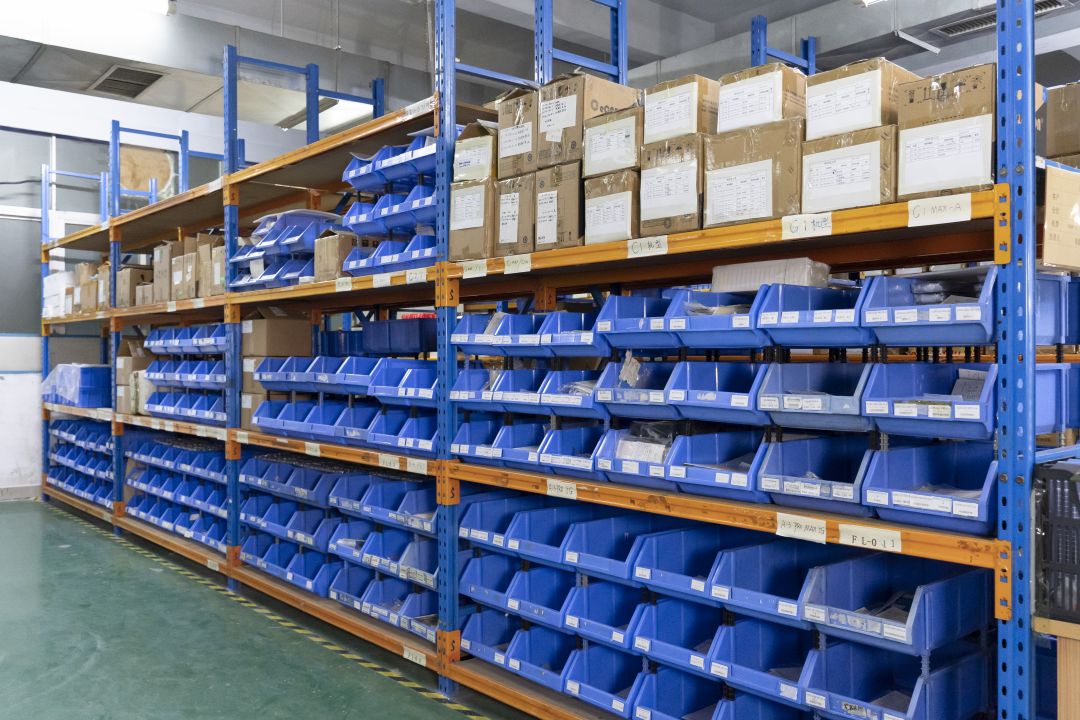
Inventory ready for sample dispatch and bulk order fulfilment at Shenzhen Keysmart Technology Co., Ltd.
Have Questions or Need More Details?
Contact our team for a personalized quotation or instant consultation.
Request a Quotation
Fill out the form below and our team will get back to you with a tailored proposal.
WhatsApp Direct Chat
Prefer to chat in real-time? Message us on WhatsApp for instant assistance & quick answers.
- Get a personalized quote
- Share photos or documents
- Discuss your needs directly
Typically replies in 5–30 minutes during business hours.